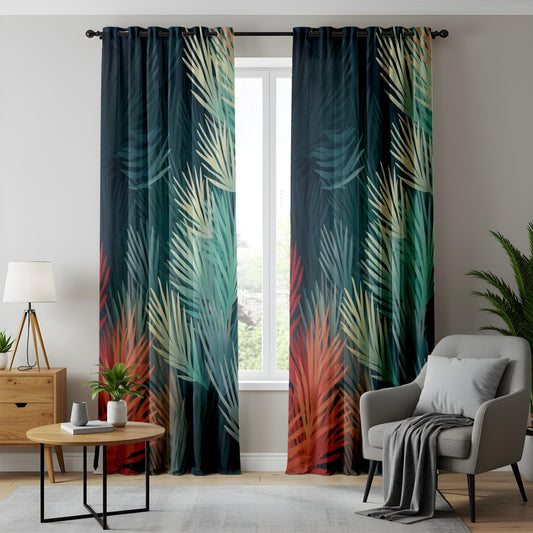
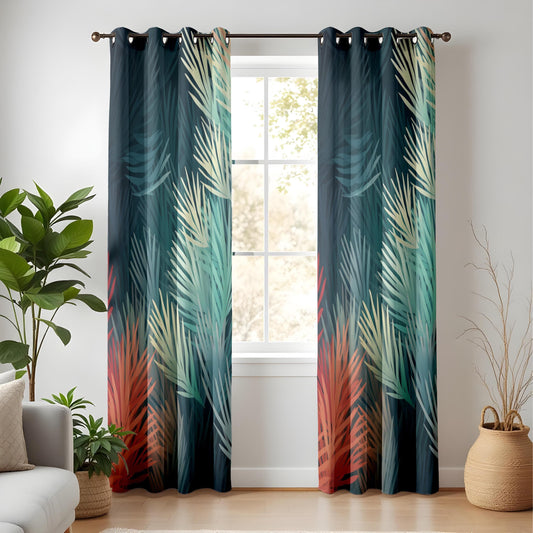
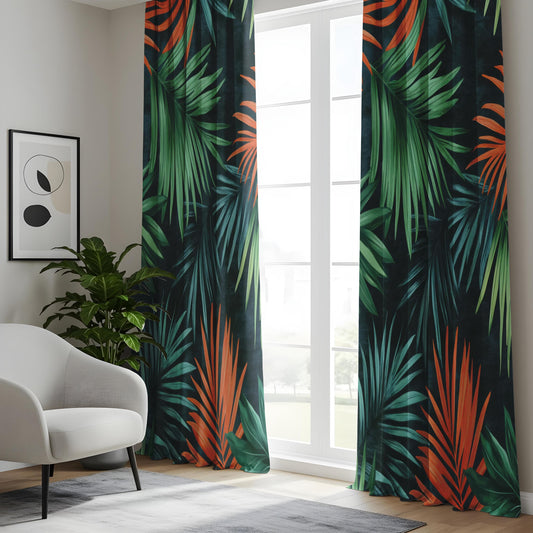
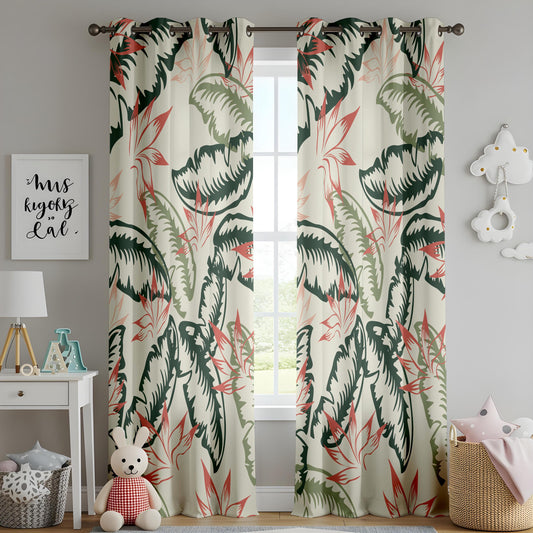
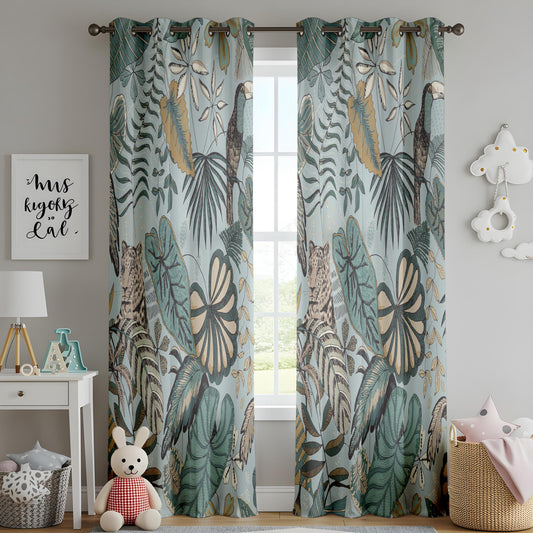
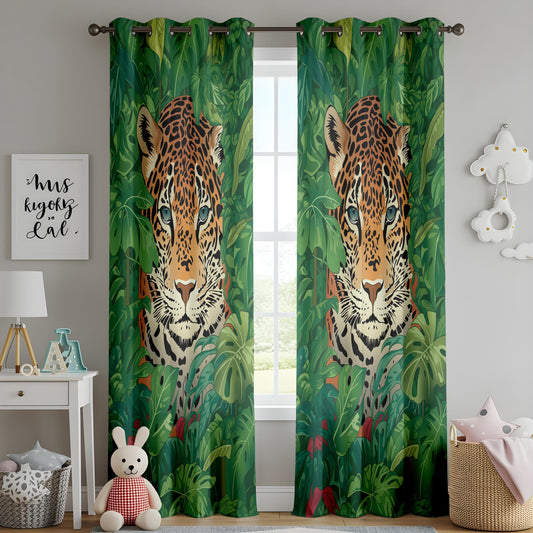
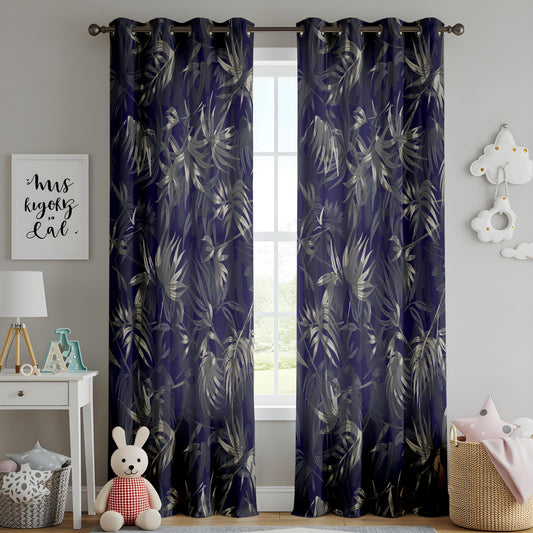
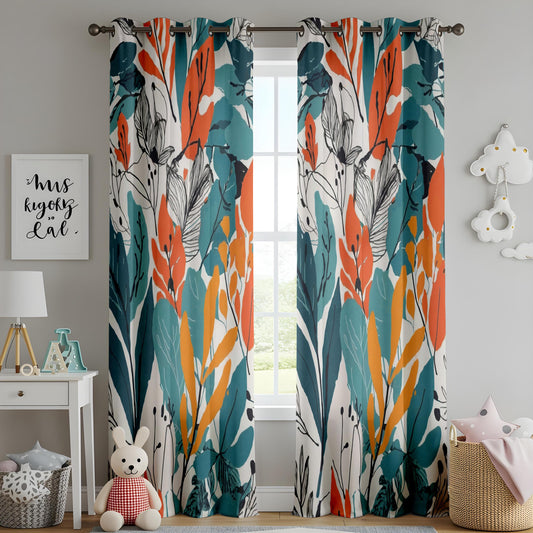
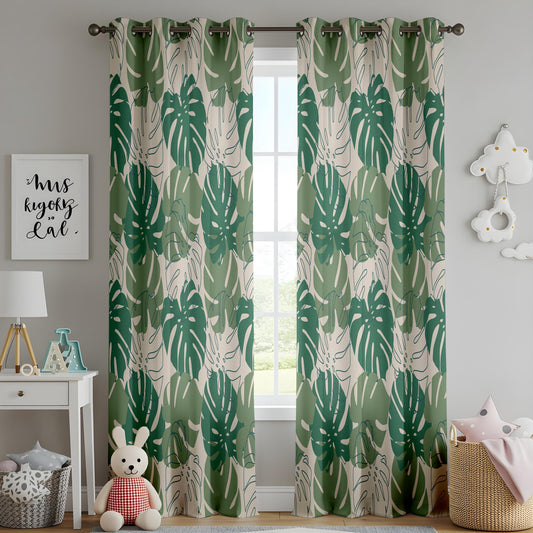
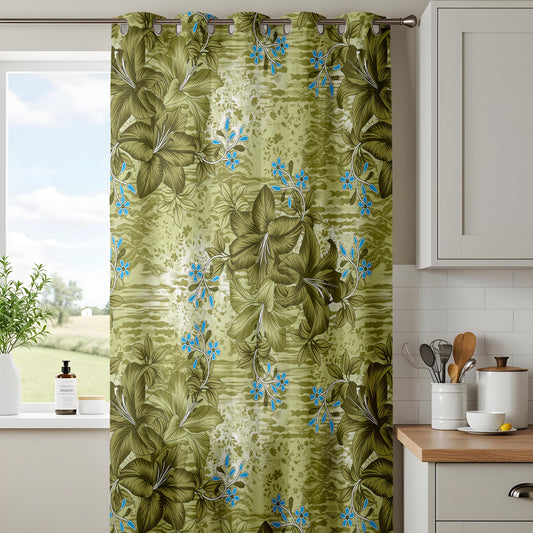
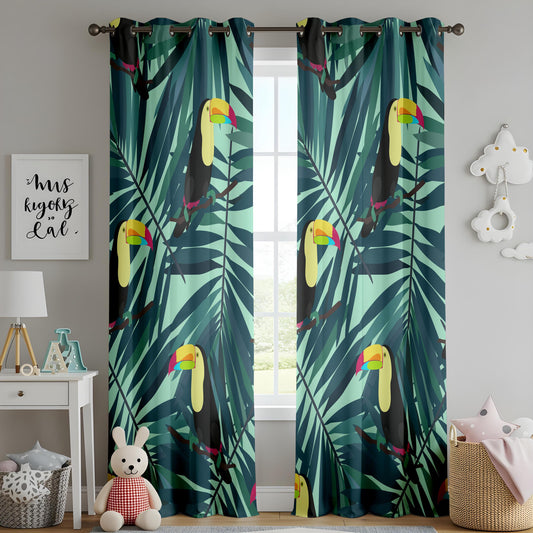
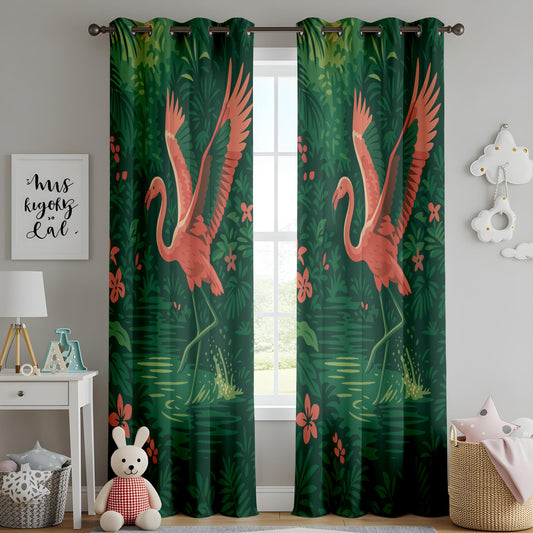
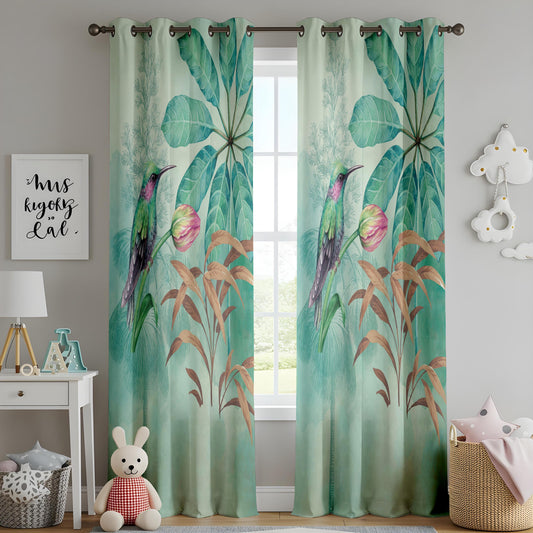
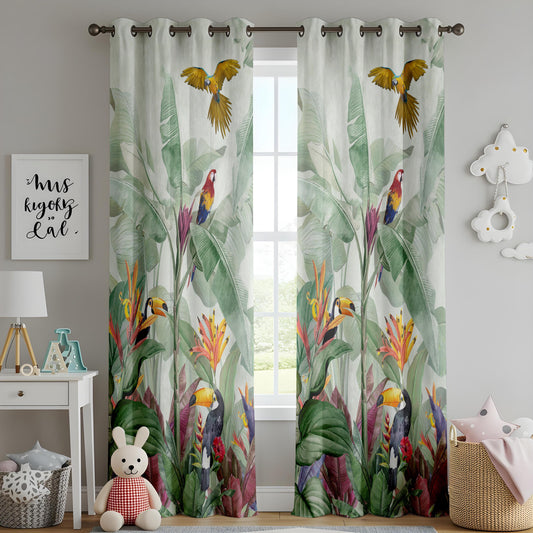
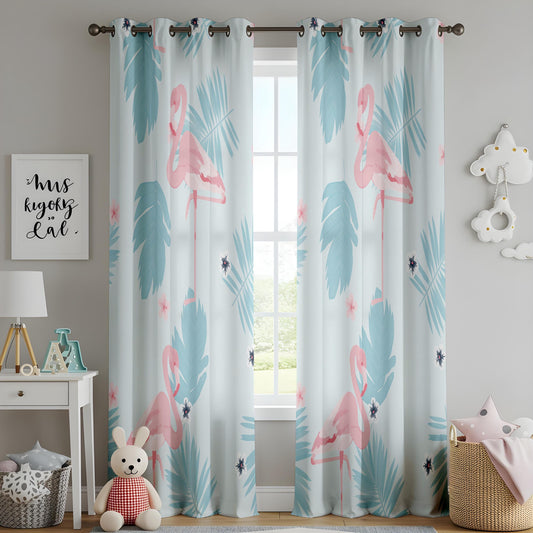
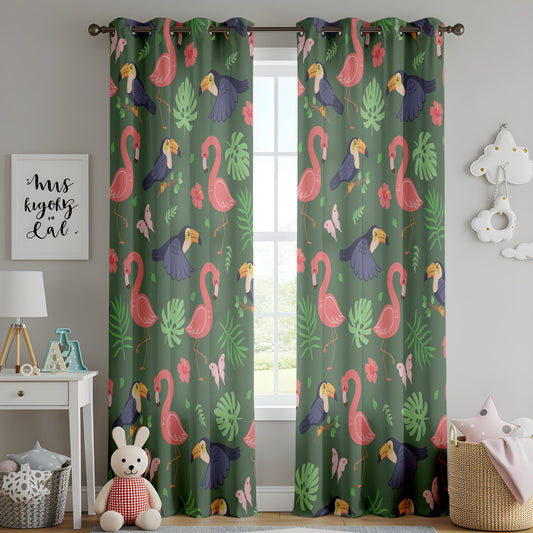
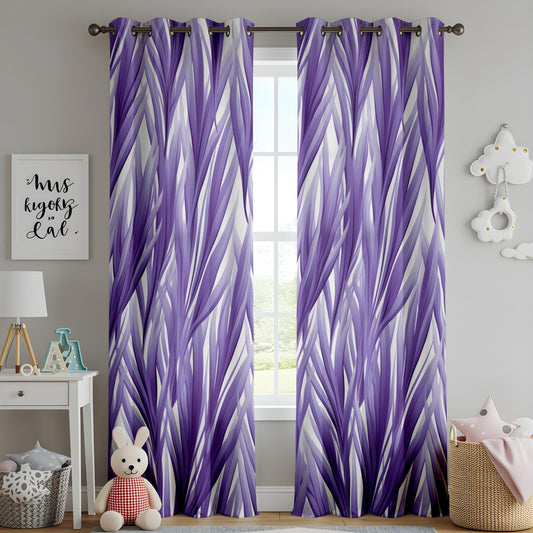
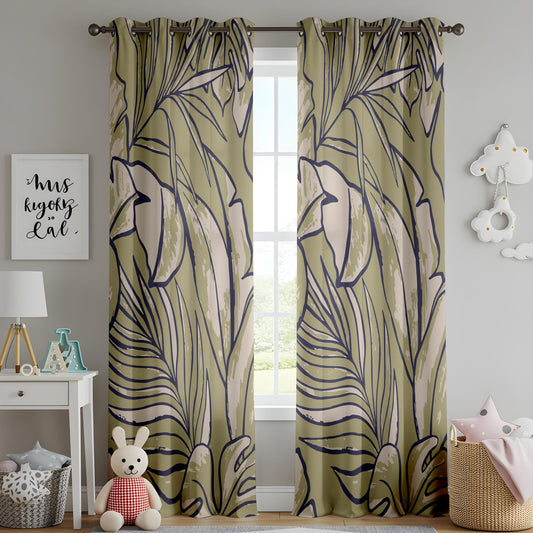
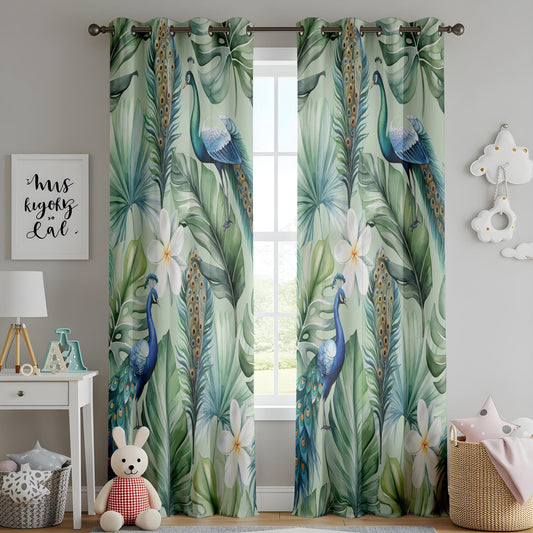
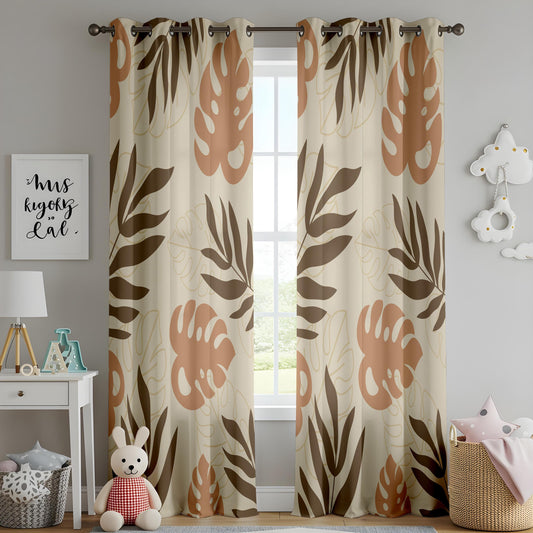
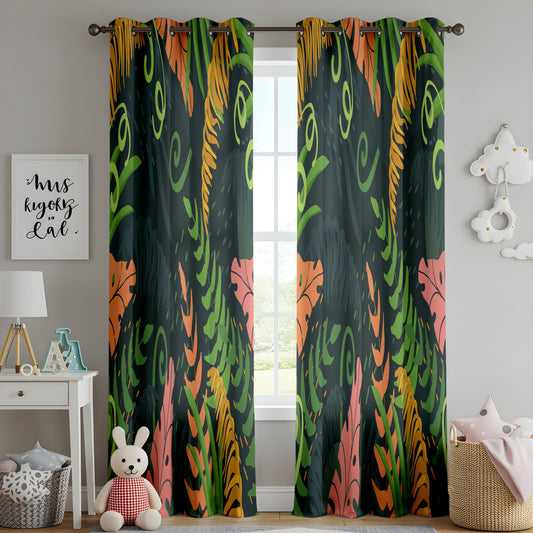
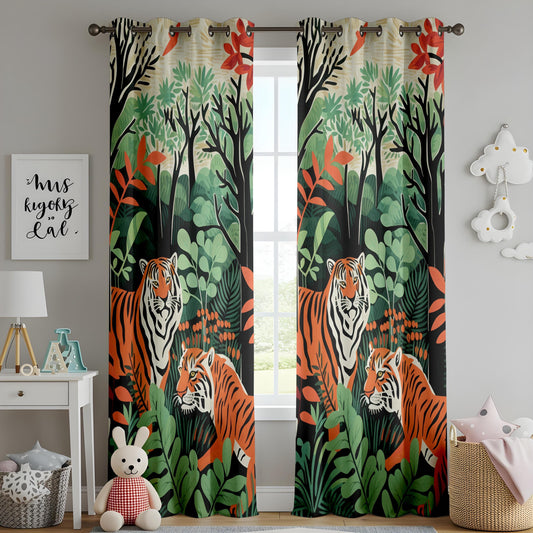
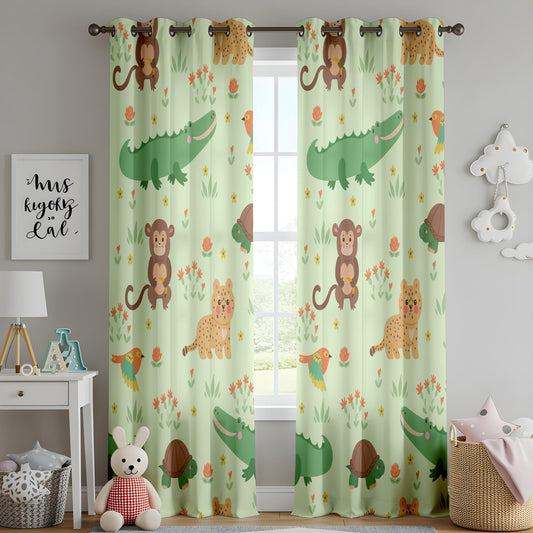
Tropical curtains are the boldest thing this collection does. Monstera and banana leaves at full scale, birds of paradise, toucans and flamingos, hibiscus and jungle canopy in saturated greens, pinks and golds. These are prints that change a room rather than decorate it. Used well, they turn an ordinary window into the reason people walk into the space. Every design is printed to your exact measurements and available unlined, with blackout lining or with thermal blackout lining.
What a Large Scale Tropical Print Actually Does
Big foliage prints work because they create depth. Layers of overlapping leaves read as distance, which makes a flat wall of fabric feel like a view rather than a surface. That is a genuinely useful effect in a room with no outlook, a basement flat, a north facing bedroom or a window that looks straight at a fence. You are effectively giving the room something to look at.
-
Creates depth where there is none. Overlapping foliage reads as layers, which gives a flat window the illusion of a view.
-
Carries a whole room on its own. One tropical window means the rest of the space can stay plain and still feel considered.
-
Warms up cold light. Saturated greens and pinks counteract the flat grey light of a north facing room in a way that neutral fabrics cannot.
Balancing a Bold Print
A tropical print needs room to be seen. That means resisting the urge to add more pattern and instead giving the print space: plain walls, solid coloured upholstery and natural textures. The other decision that matters is the ground colour. A dark jungle ground makes a room enveloping and dramatic. A white or cream ground keeps it fresh and bright with the same botanical energy.
-
Living rooms. Full length panels on a wide window make the strongest case for this style. Keep the sofa plain and pick up one leaf colour in the cushions.
-
Bedrooms. A dark jungle print with blackout lining creates a genuinely enveloping room. If that feels heavy, choose the same foliage on a pale ground instead.
-
Garden rooms and conservatories. Unlined panels let daylight pass through the leaves, which makes the print glow and blurs the line between the planting outside and the print inside.
-
Hallways and cloakrooms. Small rooms are the ideal place to be bold, since you pass through rather than sit in them. A large leaf print in a cloakroom is memorable and costs very little fabric.
Choosing the Right Lining
Every design in this collection is available with three lining options, so you can match the look to how the room is actually used.
-
Standard (Unlined): A single layer that lets daylight filter softly through the print. The colours stay luminous and the fabric hangs lightly, which makes it the natural choice for kitchens, dining rooms, hallways and any room where you want brightness rather than darkness.
-
Blackout Lining: An opaque backing layer bonded behind the printed face. It blocks external light almost entirely, so it is the option for bedrooms, nurseries, shift workers and home cinemas. It also adds body, giving the curtain a fuller, heavier fall.
-
Thermal Blackout Lining: Everything the blackout lining does, plus an insulating layer that slows heat loss through the glass in winter and reduces solar gain in summer. If you are trying to bring heating bills down or you have a draughty bay window, this is the one to choose.
Each design is also available as a single panel or a pair, in ten standard drops, so you can dress a narrow landing window and a wide living room bay from the same collection.
Made to Measure, Made to Order
Nothing in this collection sits in a warehouse waiting to be picked. Your fabric is printed and your curtains are sewn after you order, which is why the size and lining you choose are made exactly as specified rather than approximated from stock. Production takes 8-10 days, and delivery is free worldwide.
If you are torn between two designs, order fabric samples first. Screens shift colour, and a print that reads as soft sage on a phone can look considerably deeper against your own wall in your own light. A sample costs a fraction of a full order and removes the guesswork entirely.
Frequently Asked Questions About Tropical Curtains
1. Is a tropical print too much for a small room?
Small rooms are often the best place for one. You spend less time in them, so a bold decision is enjoyable rather than tiring, and a large print gives a cramped space personality instead of drawing attention to its size. The rule is to be bold in one place only: a strong print at the window, and plain everything else.
2. Will tropical curtains date quickly?
Botanical foliage has been a decorating staple for well over a century, so the subject itself is durable. What dates is treatment and colour: a print tied tightly to one season's fashionable palette will age faster than one built on natural greens. Choosing foliage in colours that occur in actual plants is the simplest way to avoid the problem.
3. What wall colour goes with a tropical print?
Take the quietest colour in the print and use it on the walls, rather than the loudest. If the design is bright green foliage on cream, a soft cream or warm off white wall lets the curtain lead. Painting the walls the same bright green removes the contrast and the print stops reading as a feature.
4. Do tropical prints work in a north facing room?
They are one of the better answers to a north facing room. That flat, cool light drains warm colours from a space, and saturated greens, pinks and golds push back against it. Choose a print with a light ground so you are adding colour without also absorbing what little daylight the room receives.
5. Should I choose a dark or light background for a jungle print?
It is the single biggest decision in this collection. A dark ground makes the room feel enclosed, dramatic and evening oriented, which suits a snug, a dining room or a bedroom. A light ground keeps the room airy and daytime oriented, which suits a living room, a kitchen or any space that is already short of light. The foliage can be identical and the two will feel like different rooms.
6. How do I measure my windows for made-to-measure curtains?
Use a metal tape measure, not fabric. Width: measure your pole or track, not the window, and let the pole extend 15cm to 30cm beyond the glass on each side so the curtains can stack back without blocking light. Drop: measure from the pole or track down to where you want the curtains to finish: 1cm above the sill, 15cm below the sill, or 1cm to 2cm off the floor for full length.
7. What is the difference between blackout and thermal blackout lining?
A blackout lining is about light: an opaque layer that stops daylight and streetlight coming through. A thermal blackout lining does the same job and adds an insulating layer that slows heat moving through the window, keeping rooms warmer in winter and cooler in summer. If your priority is sleep, blackout is enough. If it is comfort and energy bills, choose thermal blackout.
8. How should I clean my printed curtains?
Professional dry cleaning only. The printed face and the bonded blackout and thermal linings do not respond well to machine washing, which can shrink the fabric and separate the lining. Between cleans, a vacuum with the soft brush attachment on a low setting keeps dust from settling into the weave.
9. How long will my order take, and what does delivery cost?
Every order is printed and sewn from scratch, so allow 8-10 days for production. Delivery on curtains is free worldwide. Orders to the United States are sent DDP, meaning import taxes and duties are already covered and there is nothing to pay when the parcel arrives.
Explore more: Nautical Curtains, Kids and Nursery Curtains, Floral Curtains, Green Curtains and Blue Curtains. Or narrow the choice by lining with Blackout Curtains and Thermal Curtains, or browse every design in Curtains.